What does this speed test measure?
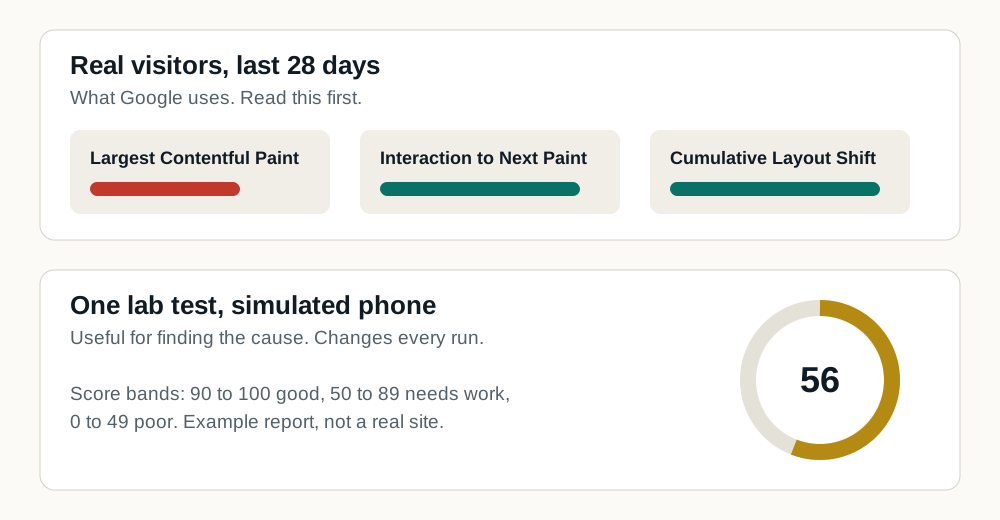
The test queries Google's PageSpeed Insights service for your address on a mobile device profile, and reports two different things that are often confused.
- Field data: Core Web Vitals collected from real Chrome users who visited your site over the previous 28 days. This is what Google assesses, and it only appears once a site has enough traffic.
- Laboratory data: a single controlled test run in a simulated environment. Useful for diagnosis, not a measure of what shoppers experienced.
- Third-party breakdown: the entities loading on your page, ranked by how long they blocked the main thread. Every entry on it has an owner inside the dealership or one of its agencies.
Why does the third-party list matter most?
Dealer websites accumulate inventory feeds, chat, trade tools, digital retailing, analytics, advertising pixels and compliance scripts. Each was added for a reason, and together they compete for the same browser time.
The consistent finding across this industry is that platform choice explains less of the variance than the third-party stack running on top of it. The blocking-time column is where that shows up. A tool contributing several hundred milliseconds is worth a conversation with the vendor that supplied it.
Why is one score not enough?
A shopper may enter through inventory, a vehicle-detail page, a paid landing page or a service page. Testing only the homepage can hide the experience on the pages closest to a lead.
Repeated tests also vary. Laboratory and field measurements answer different questions, and network conditions, test location, server response and third-party behavior all move the number, which is why field data over a 28-day window is more trustworthy than any single run.
How do I read my result honestly?
- 01
Field data first
If field data is present, that is the real answer. A good laboratory score with poor field data means real shoppers are having a worse time than the simulation suggests.
- 02
No field data is not a failure
Google only reports field data once a site has enough traffic. Smaller rooftops often have none. Use the laboratory result for diagnosis instead.
- 03
Test more than the homepage
Search results pages and vehicle detail pages usually carry more third-party weight than the homepage. Run those too.
- 04
Repeat before concluding
A single run at a single moment is not a verdict. Run each page several times before drawing conclusions.
Why is there no email wall?
Because the measurement is Google's public data and gating it would be charging admission to something that is free. A dealership evaluating vendors should be able to establish its own baseline before it talks to any of them, including us.
Nothing about the test is stored. The address you enter is sent to Google's PageSpeed Insights API to fetch the result and is not saved, not associated with you and not added to any list: the privacy policy says the same thing in more detail. If you want a review of what the numbers mean for your specific site afterwards, ask for one; if you do not, the result is yours either way.
Sources and further reading
External sources support the general technical guidance on this page. They do not represent a DealerSpeed Engine performance result.