01

What is laboratory data?

Lighthouse loads a page under controlled test conditions and reports performance opportunities. It is useful for reproducing technical issues and comparing consistent test runs.

02

What is field data?

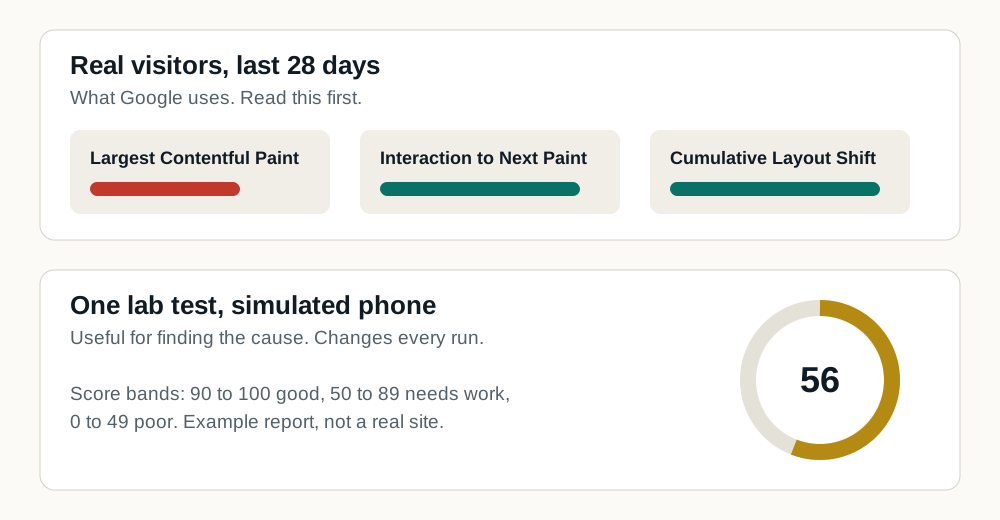
Field data comes from opted-in Chrome users and reflects an historical distribution of real experiences. Testing a dealer site properly means reading that distribution before reading the laboratory score underneath it. Some URLs simply lack enough traffic. Without URL-level field data, origin-level data may be the only available view.

03

Does the PageSpeed score reflect the shopper experience?

A single numerical score simplifies many measurements. Dealers should also look at how quickly inventory, vehicle information and lead actions become useful.

Google recommends good Core Web Vitals as part of page experience, while also stating that a perfect score does not guarantee top rankings. What speed does and does not do for dealer SEO covers that boundary in full.

04

Where does Speed Engine fit?

Speed Engine changes the loading process instead of only reporting it. PageSpeed can help document the laboratory effect, while controlled real traffic can document the live effect.

05

How do you read a PageSpeed report?

Three panels describing the parts of a Google PageSpeed Insights report for a dealership page: the field data section, which appears only when Google has enough real-user data; the laboratory score produced by Lighthouse in one simulated run; and the diagnostics and opportunities list. Each panel says what that part answers and what it cannot answer.
The three parts of the report and the different question each one answers. Reading them as a single number is what produces the wrong conclusion.
  1. 01

    Field data, if present

    The top section reports real Chrome users over the previous 28 days. This is what shoppers experienced and what Google assesses. If it is absent, your site does not yet have enough traffic in the window: common for smaller rooftops and not a fault.

  2. 02

    The three Core Web Vitals

    Read pass or fail per metric instead of the composite number. All three must pass, on the device profile you care about.

  3. 03

    The performance score

    A weighted summary of laboratory metrics from one simulated run. Useful for diagnosis, unreliable as a headline, and the number most likely to be misquoted in a meeting.

  4. 04

    Diagnostics and opportunities

    The actionable part. Third-party summary, largest contentful paint element, unused JavaScript and layout shift contributors tell you what to change.

06

Why does the PageSpeed score change between runs?

  • Network conditions and test server location vary run to run
  • Third-party scripts respond at different speeds at different times
  • Advertising and personalization can serve different payloads to different runs
  • Inventory changes alter image count and page weight
  • Caching state differs between a cold and a warm request
07

What does the PageSpeed score not tell you?

It does not tell you where you rank. Nor does it predict what you would rank if you improved it. Core Web Vitals are part of page experience, and relevance and content quality carry more weight in Google's ranking systems.

It also does not tell you what a shopper felt. A page can score well and still be frustrating if the delay lands exactly when someone is trying to interact, which is why Interaction to Next Paint exists as a separate metric.

08

What is the difference between lab and field data?

Laboratory data versus field data in PageSpeed Insights
PropertyLaboratory dataField data
What it isOne simulated run on emulated hardwareReal Chrome users over 28 days
AnswersWhat could happen under set conditionsWhat actually happened to shoppers
Used by Google to assessNoYes
Available for low-traffic sitesAlwaysOnly with enough traffic
Best forDiagnosing causesJudging the real experience

Sources and further reading

External sources support the general technical guidance on this page. They do not represent a DealerSpeed Engine performance result.