This guide is part of the dealer website speed resource library.
How should a dealership use this checklist?
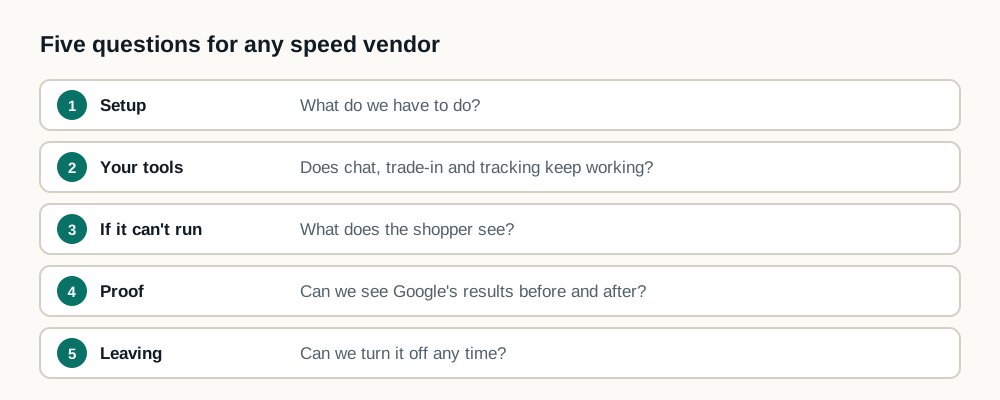
Send it before the demo, not after. A vendor who has answered these questions in writing has already told you most of what you need to know, and a vendor who deflects them has told you the rest. These apply to every product in this category, including ours: a short version of the same checklist sits on our own alternative page and the same answers are published across this site.
The questions are grouped the way a purchase actually goes wrong. Installation problems cost you a week. Safety problems cost you a broken lead form on a Saturday. Measurement problems cost you a renewal you cannot justify. Commercial problems cost you the exit.
Installation and compatibility questions
The purpose of this group is to establish what actually changes on the website and who is responsible when it does. A product that requires a migration is not a speed product; it is a replatforming project with a speed argument attached.
- Does the product require a redesign, migration, or removal of tools?
- Which platforms, page templates, and integrations are supported?
- Who installs, verifies, updates and removes it?
- What does dealership staff manage after installation?
Safety questions
This is the group most buyers skip and the group that determines whether a bad week becomes a bad quarter. Any layer that sits between a shopper and the dealership website can fail, and the only question that matters is what the shopper sees when it does.
A satisfactory answer names a specific fallback, the original website, unmodified, and a specific time limit after which the layer stops waiting. An unsatisfactory answer is a reassurance without a mechanism. The safety standard published on this site is what a complete answer looks like.
- What happens if the optimizer cannot initialize?
- If your layer is slow, does my page wait for it, and what makes you stop and hand the page back?
- What will you agree in writing never to touch on my site, and do I decide that list?
- How are chat, trade, retailing, consent and lead functions verified?
- What is the rollback process?
Measurement questions
A vendor who measures before-and-after cannot separate their effect from your seasonality, your inventory turn, your campaigns and your platform's own release schedule. That is not a technicality: dealership traffic moves enough month to month to manufacture an improvement that is not there, and to bury one that is.
The answer you want is a concurrent control group: part of your traffic keeps the original experience while part gets the optimized one, at the same time, on your own visitors. Why a split test beats a before-and-after sets out the reasoning, and the measurement methodology sets out what has to be fixed before the test starts.
- Is real traffic split between original and optimized experiences?
- How are eligibility, assignment, bots, cache and exclusions handled?
- Are lab diagnostics kept separate from field observations?
- Are page set, dates, sample, devices and limitations disclosed?
Commercial and evidence questions
Price is the least interesting commercial term. What matters is the exit: what happens to the tag if you leave, whether pricing changes after year one, and whether anything about the website is harder to move afterwards than it was before.
On evidence, the single strongest red flag in this category is a specific percentage improvement quoted for your dealership before anyone has measured your dealership. Nobody can know that number in advance. A vendor offering it is either guessing or relying on you not to ask how they got it.
- What is included in price, implementation, reporting and support?
- What are the term, cancellation, renewal and data-retention rules?
- Can every published result be tied to a named method and approved evidence?
- Are ranking, lead, conversion, or revenue outcomes promised without proof?
What does a good answer sound like?
Vendors rarely refuse to answer these. What varies is whether the answer names a mechanism or only a reassurance, and that distinction is the whole evaluation.
| Question | A good answer names a mechanism | A red flag |
|---|---|---|
| What happens if your layer fails? | The original site loads unmodified, after a stated time limit | “It is very reliable” |
| How is the result measured? | A concurrent control group on our own traffic, field and lab reported separately | A before-and-after screenshot |
| How much faster will we be? | Unknown until it is measured on this site | A specific percentage, quoted before any measurement |
| Which pages are supported? | Named templates, including search results and vehicle detail pages | “The whole site”, with only a homepage demo |
| Which of our tools were verified? | A written list, produced from this dealership's own site | “It works with everything” |
| How fast is rollback? | Immediate, documented before signature | “Raise a ticket and we will look at it” |
What should I do with the answers?
Write them down and compare them side by side instead of vendor by vendor. The differences between products in this category are rarely in the pitch and almost always in the failure behavior, the measurement method and the exit terms: three things that never appear on a comparison slide.
Then run your own baseline before anyone changes anything. The free speed test gives you your current field data and the third-party breakdown behind it, which means the first number in the conversation is yours instead of a vendor's.
Sources and further reading
External sources support the general technical guidance on this page. They do not represent a DealerSpeed Engine performance result.