01

What is server response time?

Server response time is the wait between the browser asking for a page and the first byte of that page coming back. Everything else, the stylesheet, the photographs, the scripts, the rendering, happens after it, which is why it is the one number that is added to every other number on the page instead of overlapping with them.

On a dealership website the response is not usually a static file being read off a disk. It is an application assembling a page: looking up the vehicle, the pricing, the incentives and the availability, often from more than one system. That is real work, and how long it takes is a property of the platform and its hosting instead of of anything the dealership installed.

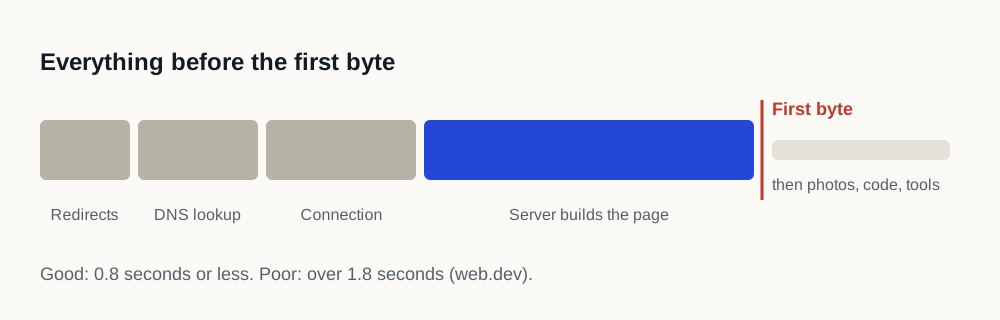
Four ordered stages of what happens before a dealership page can begin rendering: the browser asks for the address, the connection is established, the application builds the response, and the first byte arrives, only after which the page itself starts. The drawing separates the wait for the first byte, which belongs to the host and the application, from the weight of the page, which belongs to whatever the dealership installed on it.
The four stages before a page can begin. Everything on the page queues behind them, which is why this wait is separated from page weight in every standard tool.
02

How do you tell a slow host from a heavy page?

By reading the two figures separately, which every standard tool reports. If the first byte is quick and the page still feels slow, the problem is what the page loads afterwards. If the first byte is slow, nothing downstream can compensate. A perfectly optimized page that starts late finishes late.

Two different problems, two different owners
SymptomWhat it points toWho can change it
Slow first byte, light pageApplication or hosting responseThe website platform provider
Quick first byte, slow to become usablePage weight and script executionThe dealership's tool stack
Slow first byte only on some templatesOne page type doing expensive work, often inventory searchThe platform provider, per template
Slow first byte only for some visitorsDistance, or a cache that is not being hitDelivery configuration
Both slowBoth problems at once, which is commonBoth, and worth sequencing deliberately
03

Does a content delivery network fix this?

A content delivery network fixes distance. A network of edge locations shortens the trip for a visitor who is far from the origin server, and for static files it can answer without involving the origin at all.

It does not make a slow application faster. If the page has to be assembled per request, and an inventory page usually does, then the work still happens at the origin and the visitor still waits for it. A delivery network in front of a slow application produces a page that arrives efficiently, late.

04

What should a dealership actually do about it?

  1. 01

    Measure it per template

    Homepage, a search results page and a vehicle detail page. They frequently differ by more than the difference between two platforms, because they do different amounts of work.

  2. 02

    Measure it more than once

    A single measurement catches a cold cache, a deployment or a busy moment. Repeat across times of day before concluding anything.

  3. 03

    Separate it from the rest

    Write down the response time and the page weight as two numbers. Most arguments about dealership website speed are two people describing different ones.

  4. 04

    Take it to the right vendor

    Response time is the platform provider's to answer. Page weight is the dealership's stack, and the third-party inventory is the evidence for that half.

  5. 05

    Ask what is being assembled

    If one template is much slower than the others, something on it is doing expensive work per request. That is a specific question with a specific answer, not a general complaint.

05

Where does this fit against the shopper metrics?

Server response time is not a metric Google reports directly. It is a component of one: the wait before the first byte is part of the total time before the largest visible element appears. A page cannot paint faster than it arrives.

That is the practical reason to settle it first. Optimizing images and scripts on a site whose first byte is slow improves the part you can see and leaves a fixed delay underneath everything, and it is a frustrating way to spend a quarter.

Sources and further reading

External sources support the general technical guidance on this page. They do not represent a DealerSpeed Engine performance result.