01

Map the dependency chain

Identify the initiating script, follow-on requests, callbacks, global variables, page templates, consent requirements, and business owner. A resource that looks optional may be required by a later transaction step.

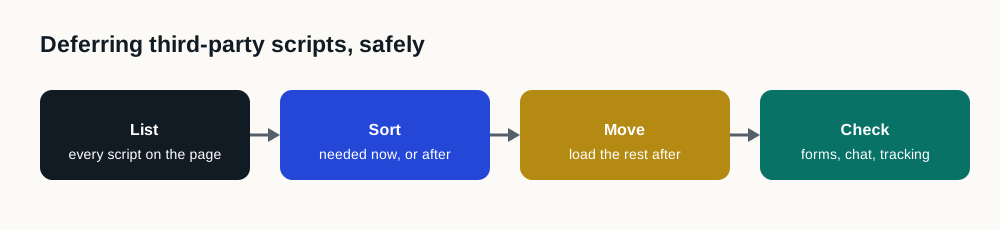
A dealership page loading in two orders. In the first, third-party tools load ahead of the inventory, pricing and lead actions a shopper came for. In the second, the shopper-facing content is served first and the third-party tools follow.
Optimization changes the order, not the contents. Everything that loaded still loads; what changes is what the shopper waits behind.
02

Classify timing safely

The safe sequence, and what to verify at each step
StepWhat it producesWhat must be true before moving on
Map dependenciesA list of what loads what, and what breaks if each is delayedNothing on the list has an unknown owner
Classify by requirementEvery tag placed in one of four timing classesA named person agrees with each classification
Change one thingA single timing change, in isolationThe change can be reversed in one action
Test the shopper pathsConfirmation that lead, chat, trade and finance still workEvery path was exercised, not just the homepage
Keep rollback readyA way back that does not need the vendorIt has been tested, not assumed
  • Protected and required immediately
  • Required before a defined shopper interaction
  • Safe after primary content becomes usable
  • Duplicate or unused pending owner approval
03

Design for failure

Decide in advance what the page does when the change cannot be applied: before you make the change, not after something breaks. The answer that keeps a dealership trading is that the original page is served exactly as it was, with nothing missing and nothing half-applied.

This is the step most often skipped, because it only matters on the day something goes wrong. A vendor who cannot describe their failure mode has not designed one, and the dealership finds out in production.

04

Test and compare

Exercise inventory filters, VDP media, pricing, chat, trade, retailing, forms, consent and mobile navigation. Compare control and optimized traffic while keeping lab data separate from field data.

05

Why build a map of what depends on what first?

The way naive optimization breaks a site is by deferring something another script needed, which is why the safety standard treats the list of what must not move as something agreed per site instead of a setting. The tool that broke does not announce itself; it simply stops working, and nobody notices until a shopper complains or a lead does not arrive.

Before changing when anything runs, record which scripts call which, which rely on a shared library, and which write to a data layer another tool reads. That map is the difference between a safe change and an outage nobody can explain.

06

What is the safe optimization sequence?

  1. 01

    Inventory

    Every third party on every representative page, with what it does and who owns it.

  2. 02

    Map dependencies

    What breaks if this loads later. Ask each vendor instead of assuming.

  3. 03

    Classify

    Required before render, required on interaction, required eventually, not required at all.

  4. 04

    Change one thing

    Then verify. Batched changes hide which one caused the problem.

  5. 05

    Test the shopper paths

    Inventory search, gallery, forms, chat, trade, retailing. Performance numbers do not reveal a broken form.

  6. 06

    Keep rollback ready

    Documented and immediate, agreed before the first change.

07

What does a map of what depends on what need to contain?

Enough to predict what breaks. For each third-party resource on the page: what loads it, what it loads afterwards, which global variables or data-layer keys it writes, which other tools read those, what it inserts into the page, and which business function stops working if it never runs.

That last column is the one usually missing, and it is the one that matters. A script can be safely delayed if nothing depends on its timing, and a script that looks identical can be undelayable because a second vendor reads a value it sets. Neither fact is visible from the filename or the vendor name, and neither vendor will volunteer it.

Consent is a special case worth calling out separately. Consent tooling frequently gates other scripts, so changing when it runs can change whether anything else runs at all, and the failure is silent, legally significant and easy to miss in a performance review.

08

What does a safe rollout look like?

The functional check is the part that gets skipped and the part that catches the real failures: filter inventory, advance a gallery, reveal pricing, open chat, start a trade valuation, complete a form, and confirm consent still fires. A metric improvement that arrives with a broken lead form is a regression, and the metric will not tell you.

  • Change one scheduling rule at a time, so a regression has one candidate cause
  • Make sure a page never waits on the change itself
  • Make sure an unsafe condition stops the change instead of degrading it
  • Exercise the shopper paths by hand after each change, not just the metrics
  • Keep the rollback immediate and documented before the first change, not after the first incident

Sources and further reading

External sources support the general technical guidance on this page. They do not represent a DealerSpeed Engine performance result.